Digitized/Digital Books
Pinar del Rio Province
About Digitized Books - Pinar del Rio Province
IMPORTANT: These files are for personal use only! The use of the information on this site for commercial, political, or any other purpose other than research of your family history and genealogy is strictly forbidden.
Please contact the CGC and obtain credit before using any part of this collection by emailing secretary@cubangenclub.org.
Citing online registries/information requires documenting the creator, record title, date, website name, URL, and access date to establish provenance. Effective citations for genealogy websites should include the specific database, collection name, and direct image links for the individual’s record.
This collection of digitized books or essays on Cuba focuses on the Pinar del Rio Province.
Many of our Digitized Books are free to view and download. The content that requires a Membership are labeled as “PREMIUM.”
These items are available on the Books Page for Members in our Members Only Area. A membership login is required to access those files.
About Pinar del Rio Province
The Formation of the Province of Pinar del Río (1878)
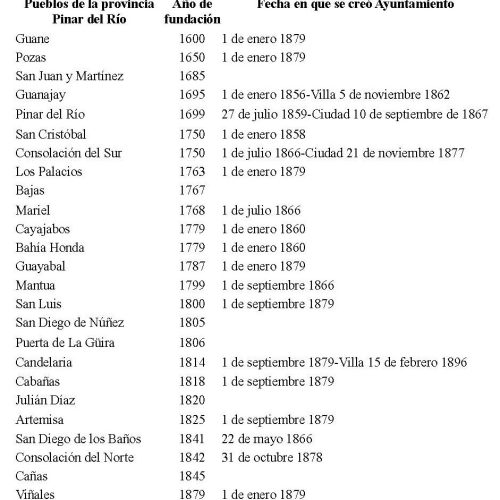
On June 9, 1878, by Royal Decree, the province of Pinar del Río was formally constituted. It was composed of the districts of Nueva Filipina, San Cristóbal, Guanajay, and Bahía Honda, with its capital established in the town bearing the same name. Brigadier Luis E. Pando was appointed as its first Governor. The creation of the province, undertaken in the immediate aftermath of the Ten Years’ War, reflected an effort to reinforce the administrative centralization of the Vueltabajo region in economic, political, and social matters. From a military perspective, the measure sought to ensure more effective control over the territory, given its strategic location in close proximity to the capital of the Island.
According to the census of 1878, the province registered a population of 190,176 inhabitants. By 1880, however, this figure had declined to 177,416. Such a reduction appears to reflect patterns of emigration toward other provinces following the cessation of hostilities, since Vueltabajo had previously functioned as a place of refuge, insulated from the direct effects of the conflict in the westernmost part of Cuba. By the time of the 1897 census, the population had further diminished to 173,082, representing a decrease of 52,800 residents in comparison with the census of 1887.
The Municipal Council of the city of Pinar del Río initially functioned in its traditional headquarters on Real Street until the building was demolished in August 1908 due to advanced structural deterioration. The institution was subsequently relocated to premises on Martí Street, at numbers 112 and 114. This property belonged to Juan María Cabada and had served as the private residence of Professors Manuel Solano Romero and Nicolás Fernández of the Secondary Education Institute. The Fire Station was, in turn, transferred to Yagruma Street, near the corner of Mercado Street, although this site was later lost when the block on Sánchez Street was destroyed by fire between February 25 and 26, 1959.
The new administrative configuration adopted by the province facilitated significant advantages for its subsequent development. In August 1883, the Secondary Education Institute was established, with Francisco Barrena y Coloma appointed as its first Director. The institution commenced operations on Martí Street, near its intersection with Nueva Street. In that same year, construction was completed on the third parish church, situated at the corner of Maceo and Vélez Caviedes Streets, thereby consolidating both the educational and religious infrastructure of the provincial capital.
Source: Apuntes para una Historia de Pinar del Rio by Wilfredo Denie Valdez, Ediciones Convivencia, Pinar del Rio, Cuba, 2012
Pinar del Rio Province
Ensayo Historico de San Luis de Occidente:Centenario Del Municipio, 1879-1979
by
Luis Osvaldo Escobar
Account of the Municipal Mayors of San Luis (Pinar del Rio) after the War for Independence
San Luiseños excelling in public office.
Pinar del Rio Province
Ensayo Historico de Pinar del Rio (1919)
by
Emeterio S. Santovenia
This essay that deals with the history of Pinar del Río. Graciously donated by CGC Member, Linet Dominguez from her personal collection.
Pinar del Rio Province
Apuntes para una Historia de Pinar del Rio (2012)
by
Wilfredo Denie Valdes
Ediciones Convivencia, Pinar del Rio, Cuba
Pinar del Rio Province
Cultura Cubana
(La Provincia de Pinar del Rio y Su Evolucion) (1921)
by
Adolfo Dollero
Imp. Seoane y Fernandez, Compostela 121
Havana, Cuba
Pinar del Rio Province
Recordando Los Palacios
by
Grupo Palaceño Para el Estudio de Nuestra Historia y Tradiciones
Memorial book for Los Palacios, printed in 2006, and graciously donated by Lourdes del Pino from her personal collection.